The National Endowment for the Arts
on
Grants for Media Arts Projects
The NEA will present a webinar covering the basics of the Media Arts funding category, how to apply to the NEA, and advice on preparing a strong application. The Media Arts staff will also take your questions.
The webinar will take place on Tuesday, January 29th from 1:00 to 2:00 p.m. EST. To join, click here (http://bit.ly/102t6Rf).
To see the full list of recent NEA grants in Media Arts, visit the Recent Grants section of arts.gov. (Click on Art Works I, Art Works II, and Arts in Media to see all of the media grants.)
Please share this information and encourage interested applicants to visit our site to read the Media Arts guidelines.
Feel free to contact us at mediaarts@arts.gov with any questions you may have.
All posts by MiaLobel
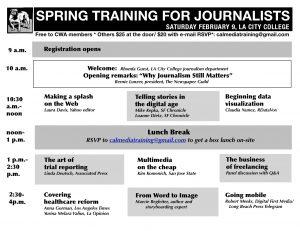
Spring Training for Journalists, Feb. 9, Los Angeles
This promises to be a great (and affordable!) event in LA, sponsored by the wonderful folks who started the Bay Area Freelancer's Guild. Don't miss it if you're in SoCal! -Mia
"Spring Training for Journalists" will be held Saturday Feb. 9 at LA City College, featuring top-notch presenters on topics ranging from digital storytelling to documentary storyboarding to covering healthcare reform. Participants can drop in for just one or two workshops or stay all day.
An event schedule is attached.
Udpates, including more detailed workshop descriptions, will be posted continually to our Facebook page:
Facebook.com/CaliforniaMediaTraining
This is our first Southern California edition of a series that's been popular in the Bay Area. "Spring Training" is aimed at working journalists (print, broadcast, online); freelancers and students are welcome.The cost is minimal — $20 with an RSVP (just e-mail your name to calmediatraining@gmail.com), or $25 at the door. Scholarships are available; CWA members (Newspaper Guild, NABET) and LACC students get in free.
If anyone has questions, I'm happy to talk to them!
-Sara
Sara SteffensThe Newspaper Guild
510-332-9483
kdmcBerkeley New Media Workshops for 2013
2013 New Media Workshops
Video Storytelling Certificate Workshop: March 25-27, 2013
This intensive three-day certificate workshop is a complete immersion in video storytelling. Participants will receive hands-on training in every phase of planning, production and digital delivery. You'll experience working in the field to capture live video, learn to edit in Adobe Premiere Pro CS5 and the tools for uploading to the web. Master storytellers will share techniques on how to capture your audience's attention.Tuition: $1,495 Register by 3/1/2013 for 10% discount.
Data Visualization Certification Workshop: March 8-9, 2013
Learn to create a more meaningful picture with data, tell stories with interactive GIS maps, and create beautiful and effective graphs and charts in this two-day certificate workshop.
Tuition: $645 Register by 02/21/2013 for 10% discount.
Multimedia Storytelling Institute: June 10-21, 2013
Upgrade your multimedia skills. This intensive 2-week graduate level certificate program focuses on the essential skills needed to be a sucessfull storyteller in the digital age. You'll work with the most recent tools and technologies for production of multimedia content. And, you'll learn to master the art of digital storytelling from master storytellers and industry leaders through seminar style discussions and practical hands-on training.Tuition: $5,400 Register by 05/10/2013 for 10% discount.
For more information please contact:
kdmcBerkeley at the Graduate School of Journalism UC Berkeley
email: vhammarstedt@berkeley.edu
Phone: +1.510.642.3892
![]()
Click to view this email in a browser
If you no longer wish to receive these emails, please reply to this message with "Unsubscribe" in the subject line or simply click on the following link:
kdmcBerkeley
UC Berkeley Graduate School of Journalism
North Gate Hall, Suite B-42
Berkeley, California 94720
US
Announcing Call for Entries for our March Rough Cut event, deadline Feb 19
Get feedback on your docs in progress. Details below! -Mia
Deadline is TUESDAY, FEBRUARY 19TH
To submit to:
ROUGH CUTS – March 2013
Tuesday, March 12th at 7:30 p.m.
The Variety Screening Room
582 Market Street, #101, San Francisco
Complimentary hors d’oeuvres provided
$9 admission
To submit, please visit:
http://sfroughcuts.com/callforsubmissions.html
And for more details about Rough Cuts, visit:
http://sfroughcuts.com/
_________________________________
Rough Cuts is a series of work-in-progress documentary screenings that are produced every other month at a variety of locations throughout San Francisco. For each evening, we screen one rough cut of a feature-length documentary and then moderate a conversation about the film. These post-screening discussions are designed to give the filmmaker a better, more objective sense of what is working and not working with his/her film, with particular attention paid to improving the film’s structure and narrative clarity. We hope that the series also provides a welcome space for local filmmakers, film professionals, and fans of documentary film to meet and talk.
We are seeking long-form works with a final running time of 40 minutes or longer. Principal photography should have been completed, and we encourage filmmakers to submit cuts that are in the later stages of post-production (i.e. NOT first or second cuts).
Please note the following dates:
Tuesday, February 19th
Submissions must arrive at the Variety Screening Room by 5:00 p.m. [This is not a postmark deadline.]
Tuesday, February 26th
Selections will be announced and filmmakers will be notified
Tuesday, March 12th
Screening, followed by a discussion led by a guest moderator
NAM Launches 2013 Women Immigrants Fellowship, deadline Feb 12
There are some great listings in this newsletter so I'm forwarding along the whole thing… take special note of the Women Immigrants fellowship. -mia
|
|||||||||||||||||||||||||||
Institute for Justice and Journalism immigration fellowship applications open, deadline Feb 22
Institute for Justice and Journalism Now Accepting Applications for 2013 Immigration in the Heartland Program
http://justicejournalism.org/news/ijj-fellowship-focus/
The Institute for Justice and Journalism is accepting applications for its 2013 Immigration in the Heartland professional fellowship program, which will focus on children in immigrant families, who count for one in four of all U.S. youngsters. The program will explore the economic and educational challenges these children face and how immigration policies have deeply impacted them, even though about 88 percent are U.S. citizens.
About 15 journalists will be chosen for the weeklong conference, “Immigration in the Heartland: Children and Families,” to be held April 21-25, at the University of Oklahoma’s Gaylord College of Journalism and Mass Communication. The application deadline is Feb. 22.
“Our program will provide journalists with information, context and reporting techniques so they can produce richer stories about immigrant children and families in their communities,” said Phuong Ly, IJJ’s executive director.
As part of their applications, journalists must propose an enterprise project on immigrant children to be undertaken through the fellowship for publication or broadcast. Each fellow will receive a $500 stipend upon completion of the story project and a “Story Behind the Story” account.
IJJ, a nonprofit based in Oakland, Calif., seeks to strengthen journalism on social justice issues through fellowships, reporting workshops, direct support of in-depth stories and the development of digital resources for reporters. Since its founding in 2000, IJJ has conducted 14 successful fellowship programs, involving more than 300 journalists and resulting in high-quality, award-winning stories and commentary.
This is the fourth year that IJJ has organized an “Immigration in the Heartland” conference in partnership with OU’s Gaylord College and its Institute for Research and Training. The Heartland programs explore national immigration topics, with special attention to Midwestern states, where immigrants are the fastest growing part of the population.
The Ethics and Excellence in Journalism Foundation has funded all four Heartland programs. The 2013 program also is supported by the Annie E. Casey Foundation, which is dedicated to helping build better futures for disadvantaged children in the United States.
This year’s program will include:
- Discussions led by experts on the impact of immigration enforcement and state laws such as Arizona’s SB1070 on immigrant families; the economic and educational conditions faced by the children; and the political mobilization of immigrant youths.
- A session on data on immigrant children and families and how to find and use data to enhance reporting, led by researchers from the Casey Foundation’s Kids Count project.
- Hands-on training using investigative tools such as FOIA and the TRAC database to get information about immigration-related agencies. The session will be led by Pulitzer Prize-winning reporter Martha Mendoza, of the Associated Press, and Dianne Solis, senior reporter at the Dallas Morning News.
- A session on demystifying immigration laws and policies, led by noted immigration attorney Daniel Kowalski.
- A visit to a charter school in Oklahoma City, where nearly all the students are from immigrant families.
Guidelines for Applicants
Eligibility
All journalists reporting stories or providing commentary for print, television, radio or online distribution are eligible. Applications are encouraged from those employed by news outlets as well as from independent journalists, including bloggers and other online content producers.
Applicants must be U.S. citizens, lawful permanent residents or non-citizens with unrestricted employment authorization. Students are not eligible.
Selection of Fellows: The selection committee will consider applicants’ professional accomplishments, individual and organizational commitment to the aims of the program, plus the quality of the story project proposal.
Terms: IJJ and the Gaylord College will provide the educational sessions, lodging and meals, and travel. IJJ also will award a $500 stipend to each fellow upon completion of the story project and “Story Behind the Story” account.
Fellows are expected to:
• Participate fully in all scheduled activities and designated online offerings, including those before the start of the program.
• Provide monthly progress reports on the status of the story project.
• Complete fellowship project stories or commentary and a “Story Behind the Story.”
• Commit to remaining involved with IJJ and sharing what they have learned with colleagues and others.
Fellows’ news organizations are expected to:
• Publish or air fellowship project stories that meet their standards.
• Provide time off for Fellows to take part in the Oklahoma sessions.
• Agree to IJJ’s re-publication or broadcast of project stories (with appropriate credit).
Checklist for Applicants
Materials Required for Submission: Application materials must be submitted via email in two Word attachments.Include this material in the email:
Attachment 1. A completed application form, which can be downloaded: Heartland 2013 application.
Attachment 2.
A. A description of the enterprise project you would like to pursue as part of your participation in the program. Be as specific as possible about the story angle, your reporting strategy and potential sources and data you envision for your project. Explain why this story topic or story framing is significant. Word limit: 400 words.
B. An assessment of what you would expect to gain from the fellowship experience, and what you would bring to it (e.g. how past accomplishments relate to current professional interests). 200 words.
C. For independent journalists only: Specify where you would expect to publish or broadcast your work. Has your work been published/broadcast in that media outlet before? Word limit: 100 words.
D. Work Samples: Relevant samples of your work that demonstrate your journalistic abilities. (For work published or broadcast in a language other than English, provide a short summary in English for each sample submitted.) See application for instructions.
Letter of Recommendation
A one-page letter of recommendation is required. It should be emailed separately by the person writing the letter to ijj@justnews.org. The same Feb. 22 deadline applies.
—For members of a news staff: A letter from your supervisor endorsing the application and story project, and committing to publish/broadcast the story project if it meets its standards.
—For independent journalists: A letter of recommendation from a person familiar with your professional work and describing the basis for the recommendation, or a letter confirming interest in the journalistic project you are proposing.
Application Deadline
The complete application packet, as outlined above, must be e-mailed before 11 p.m. (applicant’s local time) on Feb. 22. The deadline also applies to the letter of recommendation. Email to ijj@justnews.org. No faxed or late applications will be accepted.
Questions
Questions may be directed via e-mail to ijj@justnews.org.
NEA Media Arts Grants
The National Endowment for the Arts is pleased to announce
application guidelines are available for
Grants for Arts Projects in Media Arts
Arts Works & Challenge America Fast-Track deadlines are March, May, and August 2013
Applicants must be:
· nonprofit, tax-exempt 501(c)(3) organizations;
· units of state or local government;
· or federally recognized tribal communities or tribes
with at least three years of programming history in order to apply.
Grant Opportunity: Art Works
The NEA's Art Works grants support the creation of art that meets the highest standards of excellence, public engagement with diverse and excellent art, lifelong learning in the arts, and the strengthening of communities through the arts. Within these areas, innovative projects are strongly encouraged.
The NEA offers grants to support the development, production, and distribution of projects that demonstrate media as art and mediaabout the arts. Media arts, as defined by the NEA, includes film, television, radio, audio, video, the Internet, interactive, mobile, and tablet technologies, video game consoles, transmedia storytelling, and satellite-delivered content as well as media-related printed works.
Art Works project types include but are not limited to:
· Media festivals, showcases, panels, workshops, and seminars.
· Curated exhibition and/or touring programs including production of program notes and commentary.
· Creation of narrative and documentary films, television and radio programs; experimental, animated, transmedia, or interactive work; performance programs delivered through media; multi-part webisodes; and video games.
· Preservation, restoration, or archiving of media art works.
· Arts journalism (For project examples, deadlines, and webinar date, please go tohttp://1.usa.gov/URFKyl)
· Arts, science, technology ( For project examples, archived webinar, and related content, please go tohttp://1.usa.gov/Vyh5NE. )
Visit the Art Works guidelines for Media Arts projects:http://1.usa.gov/TAZXZg, for complete information.
Webinar for Potential Art Works Applicants:
The NEA will present a webinar covering the basics of the Media Arts funding category, how to apply to the NEA, selecting work samples, and advice on preparing a strong application. There will be time for Q and A with NEA staff.
The webinar will be Tuesday January 29, 1:00-2:00 EDT at arts.gov. To join the webinar, go here.
A sample of recent Media Arts grants:
· Spelman College (aka Digital Moving Image Salon) in Atlanta, Georgia received $100,000 to support HERadventure, a multi-episode, augmented reality computer game targeted to young women.
· American Documentary in Brooklyn, New York received a $100,000 grant to support acquisition, packaging, and promotion of films for the public television series POV (Point of View).
· Ragtag Programming for Film and Media Art (aka Ragtag Cinema) in Columbia, Missouri received a $25,000 grant to support the True/False Film Festival and other curated film series.
· Appalshop in Whitesburg, Kentucky received a $75,000 grant to support the Thousand Kitesradio series and web platform for The Prison Poetry Workshop.
· The Metropolitan Opera in New York City received a $50,000 grant to support production and post-production costs associated with the national telecasts of Great Performances at the Met.
· Squeaky Wheel in Buffalo, New York received a $30,000 to support SWAP: Squeaky Wheel Access Program to provide free and low-cost access to media equipment, activities, and resources to film and video artists.
To see the full list of recent NEA Art Works grants in Media Arts, visit the Recent Grants section of the NEA website. (Click on Art Works I, Art Works II, and Arts in Media to see all of the grants.)
Grant Opportunity: Challenge America Fast-Track
The Challenge America Fast-Trackcategory offers support primarily to small and mid-sized organizations for projects that extend the reach of the arts to underserved populations — those whose opportunities to experience the arts are limited by geography, ethnicity, economics, or disability. Challenge America Fast-Trackgrants:
· Extend the reach of the arts to underserved populations.
· Are limited to specific types of projects.
· Are for a fixed amount of $10,000 and require a minimum $10,000 match.
· Receive an expedited application review.
To see the full list of recent NEA Challenge America Fast-Track grants, visit the Recent Grants section of the NEA website.
Visit the Challenge America Fast-Track guidelines:http://1.usa.gov/TNudik for complete information.
Deadlines for Arts Works and Challenge America Fast-Track
There are two deadlines for Art Works applications under Media Arts:
· March 7, 2013 for projects that fall under the category of engagement, learning, or livability.
· August 8, 2013 for projects that fall under the category of creation or engagement.
There is one deadline for Challenge America Fast-Track applications: May 23, 2013
Sample of NEA-Generated Media Art Content
From the Art Works blog, quarterly magazine NEA Arts, and weekly podcast series:
· Art Works Podcast: Stanley Nelson: A conversation with award-winning director Stanley Nelson, whose most recent film isFreedom Riders.
· Art Talk with Catherine Burns: A conversation with the artistic director of The Moth, one of New York’s premiere centers for live storytelling.
· Art Works Podcast: Debra Granik: A conversation with the director ofWinter’s Bone; made on a shoe- string budget, this independent film came out of nowhere and made everyone sit up and take notice.
· From the Innovation issue of NEA Arts, a profile of Chris Miller: In his career at DreamWorks Animation, Chris Miller has been engaged with nearly every aspect of animated filmmaking.
Please feel free to share this information and encourage interested applicants to visit the NEA's website at www.arts.gov for more information and contact us at mediaarts@arts.gov with any questions you may have after reading the guidelines.

Digital Storytelling Competition for Students, deadline Feb 22
Pass this along to your students! Deadline Feb 22.
http://newsaction.org/contest/
The deadline for submissions is February 22, 2013.
Students can submit work earlier for edits from American Student Radio producers. Early submissions are due January 18, 2013.
Shoot News Action a line if you have any questions/comments (info@newsaction.org), and in the meantime, round up some brilliant young mediamakers. Let's watch the future of media happen here and now.
Cheers,
Barton
President, American Student Radio
Guidelines for submissions:
Your goal is to tell a great story. Focus on one person and tell how his or her story relates to a bigger global issue. Your reporting must be original, factual and true, and it should consider multiple sides of the story. It should feature at least three voices: an in-person interview with the individual affected, an expert on the topic (like a researcher, a teacher, a doctor, or a professor), and any other third voice of your choice. That third person can be you, the narrator.
Stories can be told using any combination of infographics, audio, video, photography and text. Think carefully about the media you use to tell yours to an audience of peers around the world.
Articles must be no longer than 2,000 words. Video and audio stories must be no longer than 5 minutes. A photo gallery or infographic collection must contain no more than 10 captioned photographs.
Making Contact Call for Pitches
From the good people at Making Contact. Pitch away! -mia
Making Contact is an award-winning, 29-minute weekly magazine/documentary-style public affairs program heard on 140 radio stations in the USA, Canada, South Africa and Ireland.
Showcasing voices and perspectives rarely heard in mainstream media, Making Contact focuses on the human realities of politics and the connections between local and global events, emphasizing positive and creative ways to solve problems.
We are seeking pitches for some specific themes for the first part of 2013. Please scroll down for more detail on each theme.
1. Collective Bargaining and “Right to Work”
2. Domestic Use of Drones
3. Reproductive Health and Justice
4. Transit Justice
5. LGBTQ Healthcare Issues
1. Collective Bargaining and “Right to Work”
What is collective bargaining, anyway? Fights over collective bargaining in Wisconsin and Ohio have hit the front pages over the past couple of years. But what are we actually talking about—do Americans understand? The same goes for “Right to Work”—another phrase tossed around all the time in stories about unions. What does it mean?
We are seeking sound-rich pieces that ‘show’ the audience, through story telling, what ‘collective bargaining’ and ‘right to work’ are and how they function (or don’t function, depending on who you ask). We are not seeking academics, or even union leaders, to explain these concepts. Instead, these stories might take us through an ongoing labor struggle (or perhaps one that you have archival tape from) which makes these concepts clearly understandable. Or we might follow a worker as he or she transitions from a union to non-union job (or vice-versa) and starts experiencing the difference. Think creatively. Also note: by making clear why people support ‘collective bargaining’ or ‘right to work’, we also want to make clear why others are in opposition.
2. The Domestic Use of Drones
We already have a piece in the works from Alameda County, CA, where the sheriff wants drones and is facing resistance from the community. It will deal with the surveillance of protesters, and the ‘slippery slope’ between what law enforcement agencies say they want to use drones for, and what they could potentially be used for in the future. We are looking for stories that take on other angles in regard to drones being used on US soil. Some possibilities:
– Drones near the US/Mexico border
– The potential usage of armed drones in the US
– Ways in which local communities have successfully organized to change local government’s drone policy, or to force them to create such a policy
3. Reproductive Health and Justice
We’re looking for stories that find the human dimension in policy-heavy battles for access to birth control, abortion and the economic resources needed to choose to bear and raise a child. We especially want to explore the specific impact of reproductive health access on women of color and young women–people most affected by public policy debates that often don’t include them. We are not looking for a specific format or angle, but some possibilities are:
– “Crisis Pregnancy Centers”: their genesis and history, which neighborhoods are they most prevalent in, and their connection to larger political movements.
– Hormonal birth control and the role of the large pharmaceutical companies in the development and promotion of certain methods over others. Natural methods of birth control/fertility awareness–what are the structures and obstacles to that?
– How is the Affordable Care Act, and various state’s responses/revisions to health reform, affecting women’s access to reproductive healthcare?
– How do women resist restrictions of access to reproductive health services and abortion? Before Roe v. Wade, the Jane Collective created a safe, underground abortion network for women in Chicago. What alternatives exist currently for women/girls who lack access to safe, legal abortion?
4. Transit Justice
Issues relating to public transportation policy intersect with issues of economic inequity, air quality/climate change, race and regional demographics, mobility, age and gender.
We're looking for stories that examine systems and structures together with individual characters/community members and how their lives are affected by their region's transit policies.
Possible themes:
– Urban organizing around transit justice–eg: On the Move/Boston, Portland OPAL’s Bus Riders Unite/Portland, Bus Riders Union/Los Angeles
– Challenging “car culture” in urban communities of color
– Coalition-building between transit users and transit workers
5. LGBTT2IQQ Healthcare
We’re looking for pitches about healthcare issues for lesbian, gay, bisexual, transgender, transsexual, two-spirit, inter-sex, queer and/or questioning people (LGBTT2IQQ). We’d like to hear how the current healthcare sector does, or doesn’t meet LGBTT2IQQ needs, and alternative models that are being tried, perhaps outside the mainstream medical system. Some possible ideas:
– The campaign against "therapy" that claims to "convert" people’s sexual orientation. In California, a bill banning this kind of practice was signed into law but blocked by an appeals court.
– Struggles for healthcare equality in health plans
– Access to LGBTT2IQQ appropriate healthcare in rural and poorer areas.
This call for pitches is for segments of about 8 minutes, but we also occasionally take longer pieces (12 or 26 minutes). For shorter pieces we generally pay about $300 per story, depending on the producer’s experience. As with any pitches you send us, please check out our show and read our guidelines before you pitch. http://www.radioproject.org/production/submission-guidelines/
Consider the following. Does the story:
-
Link grassroots issues and human realities to national or international trends?
- Give listeners a historical, political, or social context of major national and international events?
- Shed light on social and economic inequities?
- Explore any alternatives or solutions?
Send pitches to pitches@radioproject.org. Please be detailed but succinct, and include a description of your idea, narrative/story arc, interview subjects, scenes, and sounds/ambi. If you’re pitching to us for the first time, please include a brief bio and relevant audio clips.
We look forward to hearing from you!
Jen Chien, Andrew Stelzer & George Lavender
Making Contact producers
Enter the 2013 Casey Medals Competition, deadline March 1
$1-5K for stories about children and families. Details below! -Mia
The awards were created to inspire and recognize exemplary reporting on children and families. Winning stories offer a fresh take on a significant issue, show enterprise in research and reporting and demonstrate masterful storytelling and impact. Judging is conducted by respected journalists and journalism educators.
The Journalism Center on Children & Families is a nonprofit resource center based at the University of Maryland’s Philip Merrill College of Journalism. More than 5,000 journalists have competed for Casey Medals since 1994. The awards are funded by the Annie E. Casey Foundation.
Sincerely,
Julie Drizin
Center Director